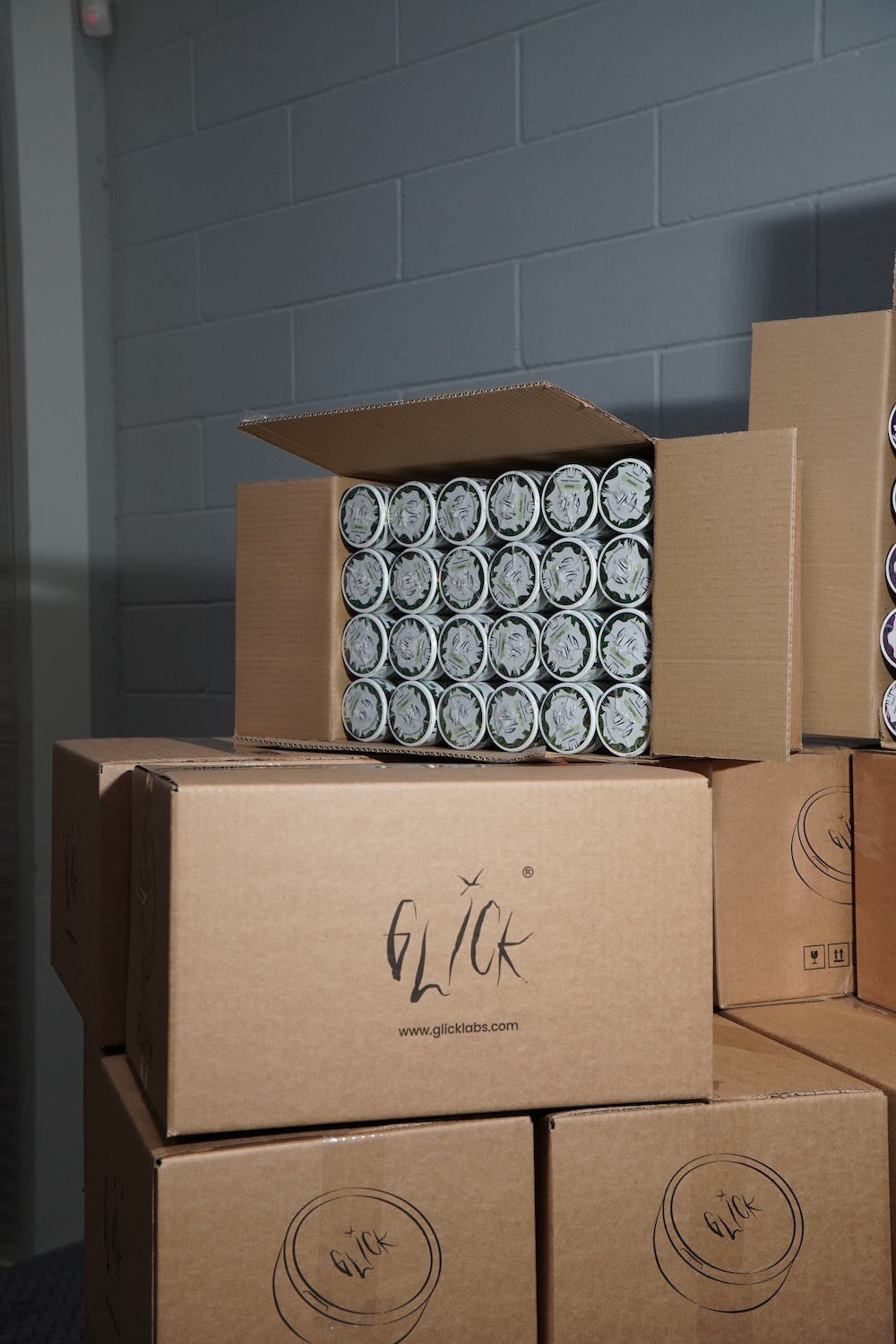
You can lawfully sell nicotine pouches in the United States, but only after meeting FDA’s premarket authorization requirements under the Federal Food, Drug, and Cosmetic Act (FD&C Act) and applicable Center for Tobacco Products (CTP) guidance. No authorization means no legal sales, and pending applications are not a grace period — FDA can enforce against your product at any time.
Before your first shipment, three things must happen: confirm your product’s regulatory classification (tobacco product or drug); pause any distribution if you lack an applicable premarket authorization or accepted filing; and begin assembling your analytical and manufacturing documentation, including Certificates of Analysis (COA), batch records, and Material Safety Data Sheets (MSDS). FDA coordinates with Customs and Border Protection (CBP) to intercept noncompliant products at the border, so documentation gaps are not just a paperwork problem.
Pouchsupply works with brands at every stage of this process, from formulation and testing coordination to COA and MSDS provisioning, making it one of the few white-label manufacturers equipped to support a U.S.-bound compliance workflow from day one.
Under section 201(rr) of the FD&C Act, a nicotine pouch is a tobacco product when it contains nicotine derived from any source and is not marketed for therapeutic use. That classification puts it under CTP jurisdiction and the Premarket Tobacco Product Application (PMTA) pathway.
| Term | Regulatory meaning |
|---|---|
| Tobacco product | Contains nicotine from any source; not marketed for cessation or therapeutic use; regulated by CTP under FD&C Act section 910 |
| Drug (CDER) | Marketed to diagnose, cure, mitigate, treat, or prevent disease or addiction; regulated by the Center for Drug Evaluation and Research |
| New tobacco product | Not commercially marketed in the U.S. before a specified date; requires premarket authorization before sale |
| PMTA authorization | FDA determination that marketing the product is “appropriate for the protection of the public health” |
The line between tobacco product and drug is crossed the moment your label or website implies the product helps people quit smoking. Marketing a nicotine pouch for cessation moves it into CDER’s drug pipeline, which requires clinical trial data and a fundamentally different review process. Most brands targeting the U.S. consumer market will stay in the tobacco product lane, but that decision must be made deliberately and reflected consistently across every label, ad, and social post.
Key statutory references to keep on file:
Three pathways exist. Most nicotine pouch brands will need a PMTA.
Statistic callout: FDA’s May 2026 enforcement guidance identifies specific enforcement priorities for unauthorized nicotine pouch products, including lack of child-resistant packaging (CRP), high nicotine content, and documented adverse experiences. A pending PMTA filing does not shield a product from enforcement if any of these disqualifying features are present.
FDA requires rigorous scientific evidence that a product is appropriate for the protection of public health. “Continuum of risk” messaging in marketing materials does not substitute for that evidence and will not satisfy the PMTA standard.
FDA tobacco rules require specific warning statements on nicotine pouch packaging. Beyond the mandatory text, several labeling and marketing choices can trigger enforcement or reclassify your product entirely.
Required and prohibited labeling elements:
Digital marketing is regulated. FDA monitors websites and social media for claims that imply therapeutic benefit. A single phrase like “helps you quit” on your Instagram page can reclassify your product as a drug. Digital claims are treated as part of the regulated product and carry the same legal weight as label text.
State and local rules add another layer. Several states have enacted flavor bans or age-verification requirements that go beyond federal rules. California, Massachusetts, and New York have each passed restrictions affecting flavored tobacco products. Check with regulatory counsel for the specific states where you plan to distribute before finalizing your product portfolio.
Pro Tip: Describe flavor and nicotine content factually: “mint flavor, 6 mg nicotine per pouch.” Never frame nicotine strength as a benefit or describe the experience in terms that suggest stress relief, focus enhancement, or cessation support. Those phrases are the ones that attract FDA scrutiny.
FDA does not publish a single mandatory test list for nicotine pouches, but PMTA reviewers expect data across several analytical categories. A gap in any of these areas will slow or sink your application.

| Test type | Purpose | Data to collect |
|---|---|---|
| Nicotine content and form | Confirm labeled strength; identify free vs. total nicotine | Quantitative analysis per pouch and per can |
| Tobacco-specific nitrosamines (TSNAs) | Primary carcinogen risk marker | NNN, NNK, NAT, NAB levels per batch |
| Heavy metals | Contaminant safety | Lead, cadmium, arsenic, chromium |
| Microbiology | Product safety and shelf stability | Total aerobic count, yeast, mold, pathogens |
| Stability | Shelf-life validation | Nicotine degradation, moisture, pH over time |
| Impurities/HPHCs | Harmful and potentially harmful constituents | Per FDA HPHC list guidance |
Beyond lab data, FDA expects a documented quality system. That means batch production records for every commercial run, Standard Operating Procedures (SOPs) covering mixing, filling, and packaging, and chain-of-custody documentation from production through lab analysis. Missing chain-of-custody for analytical samples is one of the most common operational failures in PMTA submissions.
Facility registration under FD&C Act section 905 is mandatory for domestic manufacturers and importers. Product listing must be submitted to FDA before the product enters U.S. commerce, and listings must be updated annually or when product details change.
Pro Tip: Maintain a documented sample log that tracks every analytical sample from the production batch to the certified lab and back. FDA reviewers look for this chain-of-custody evidence to validate that submitted test results actually reflect the commercial product.
A white-label manufacturer that understands FDA documentation requirements can cut months off your PMTA preparation. Pouchsupply provides COA and MSDS documentation as standard, coordinates third-party testing through certified external labs (including nicotine content, heavy metals, and microbiology), and maintains batch production records aligned with the documentation FDA reviewers expect to see.
Sample development at Pouchsupply runs approximately one to four weeks depending on formulation complexity. Pilot production and full commercial runs follow a documented QC process, with in-line checks to confirm consistency between the approved sample and the finished batch. ISO and Bureau Veritas certifications underpin the quality system, giving brands a credible manufacturing narrative for their PMTA dossier.
Pro Tip: Request that your manufacturer provides batch records in a format that maps directly to PMTA section requirements. Reformatting records after the fact is time-consuming and introduces transcription risk. Standardized COA formats from the start save weeks during dossier assembly.
For brands exploring nicotine-free or functional pouch alternatives, Pouchsupply also manufactures caffeine and nootropic pouches, which carry a different regulatory profile and may offer a faster U.S. market-entry path for some product concepts.
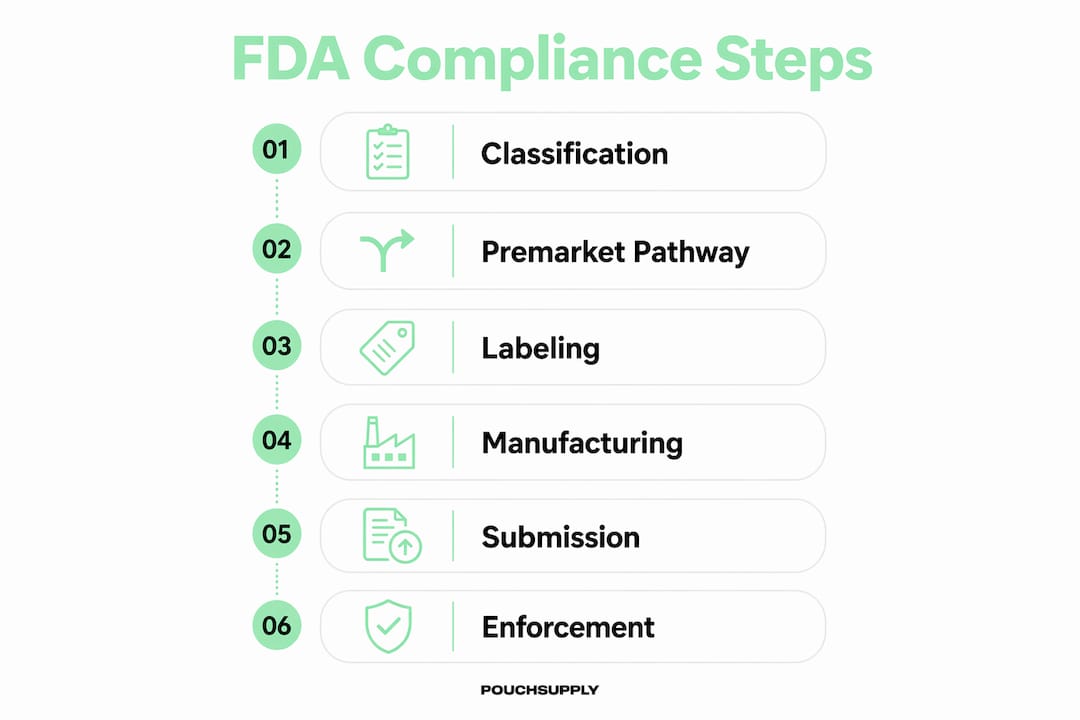
Work through these steps in sequence, but run parallelizable tasks simultaneously to compress the timeline.
FDA weighs analytical chemistry and manufacturing data most heavily in early review. Toxicology and human use data become critical when the product has novel ingredients or elevated nicotine levels. Outsource lab work to accredited facilities (ISO/IEC 17025-certified labs are the standard) and get written agreements on turnaround times before you start.
FDA and CBP coordinate to detain, refuse admission, and destroy adulterated or misbranded tobacco products at U.S. borders. The consequences of noncompliance are not theoretical.
Possible enforcement actions under the FD&C Act include: warning letters, civil money penalties, injunctions, inventory seizure, and referral to the Department of Justice. Products that are not commercially authorized are adulterated and misbranded under the FD&C Act, which means CBP can refuse their entry and FDA can seek their destruction.
To reduce detention risk at the border, importers should ensure every shipment carries accurate product declarations, compliant labeling (including CRP and required warnings), and a current product listing number. Keep COAs and facility registration documentation accessible for immediate production if CBP requests them.
If you receive a warning letter or detention notice: stop distribution of the affected product immediately, preserve all records, and engage regulatory counsel before responding. FDA warning letters carry response deadlines, and a late or inadequate reply escalates the enforcement action.
Work through these workstreams before your first shipment. Many tasks can run in parallel.
Minimum document pack before first shipment: facility registration confirmation, product listing acknowledgment, current COA for each SKU, label proofs with required warnings, SOPs for manufacturing and QC, and batch records for the production run being imported.
FDA compliance for nicotine pouches requires premarket authorization, documented manufacturing quality, and labeling that avoids any therapeutic claim, with enforcement risk beginning the moment an unauthorized product enters U.S. commerce.
| Point | Details |
|---|---|
| Classification determines your pathway | Tobacco product vs. drug classification hinges on marketing claims; cessation language triggers CDER and clinical trial requirements. |
| No authorization means no legal sales | Products not commercially marketed before a specified date are new tobacco products requiring PMTA; pending status is not a sales shield. |
| CRP and labeling are enforcement triggers | FDA’s May 2026 guidance flags missing child-resistant packaging and high nicotine content as priority enforcement targets. |
| Documentation must be built before testing | COAs, batch records, SOPs, and chain-of-custody logs must be in place from the first production run, not assembled after the fact. |
| Pouchsupply supports the documentation workflow | Pouchsupply provides COA, MSDS, batch records, and third-party testing coordination aligned with PMTA submission requirements. |
The compliance failures we see most often are not about science. They are about assumptions. A brand spends months on formulation, then writes a product description that says “helps take the edge off” and unknowingly crosses into drug territory. Another brand has solid lab data but no chain-of-custody documentation, so the test results are essentially unusable in a PMTA submission.
The other underestimated trap is state law. Federal FDA compliance gets you to the border. It does not get you onto a shelf in California or Massachusetts, where flavor restrictions and retailer licensing requirements create a second compliance layer that catches brands off guard after they have already committed to a product portfolio.
The practical fix is to treat documentation as a product, not an afterthought. Every batch, every sample, every lab submission should generate a paper trail that a regulatory reviewer could follow without asking a single question. Standardize your COA format before your first production run. Build chain-of-custody into your lab submission protocol from day one. And review every piece of consumer-facing copy, including social media bios, against the therapeutic-claim standard before it goes live.
Getting to market in the U.S. requires more than a good formula. You need a manufacturer whose documentation holds up under FDA scrutiny, and that is exactly where most white-label relationships fall short.

Pouchsupply provides white-label nicotine pouch manufacturing with COA and MSDS documentation included, third-party testing coordination through certified labs, batch production records formatted for PMTA use, and packaging support that covers CRP and mandatory warning placement. ISO and Bureau Veritas certifications back the quality system. Production capacity reaches up to one million cans per month, with a minimum order of 7,200 cans across up to three SKUs. Sample development runs one to four weeks. Commercial production completes within 30 days for most orders.
If you are building a brand for the U.S. market and need a manufacturing partner who understands what FDA reviewers look for, contact Pouchsupply to start with a product brief and get a realistic timeline for your launch.
This article is general information, not legal or regulatory advice. Confirm current FDA requirements and state-level rules with a qualified regulatory attorney or regulatory health project manager before making market-entry decisions.