E-liquid can be shipped legally in the United States, but only when three independent gatekeepers all say yes: DOT hazmat classification is correct, the PACT Act / POSECCA delivery requirements are satisfied, and your chosen carrier actually accepts vaping products. Miss any one of those, and the shipment fails regardless of how well you handled the other two.
The single most important number on your Safety Data Sheet is the closed-cup flash point. If it is 60°C (140°F) or below, your e-liquid triggers DOT Class 3 Flammable Liquid classification under 49 CFR, which means UN-specification packaging, ISHP-ordered shipping papers, and trained hazmat handlers. If the SDS does not provide a numeric flash point value, regulated carriers will not transport it.
Pro Tip: Run the carrier policy check before you order lab testing. Discovering your preferred carrier bans vape products after you have paid for flash-point testing wastes both time and money.
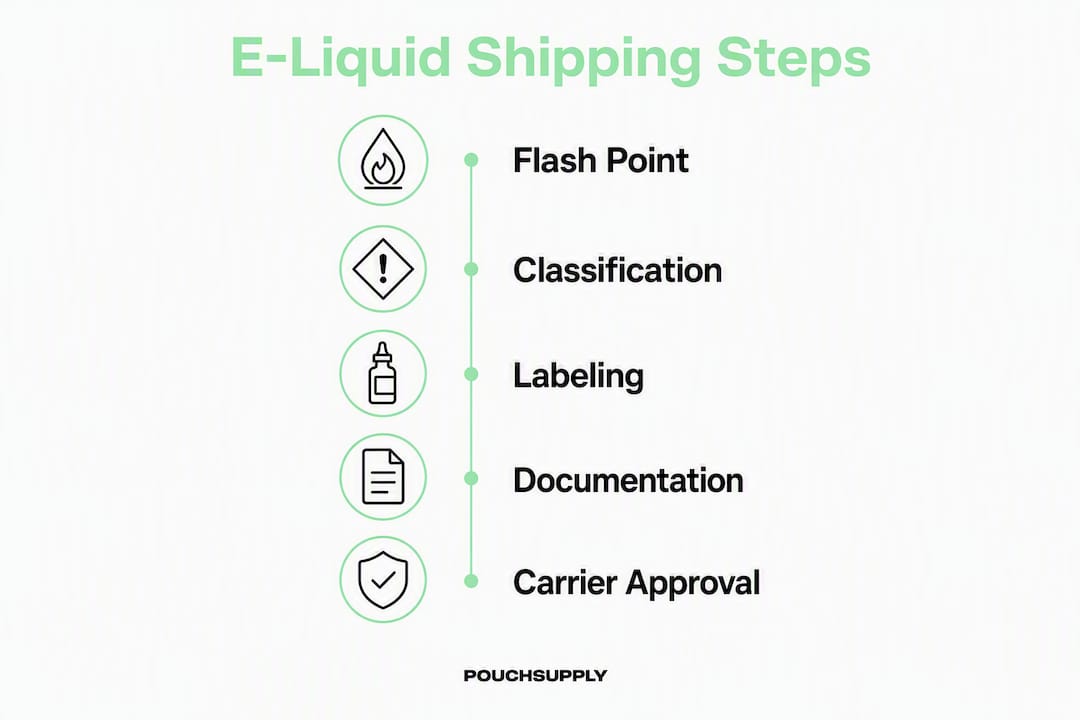
Before committing to lab testing or packaging procurement, run every SKU through these five checks. A single “no” stops the shipment.
The core compliance problem with e-liquid shipping is that three legal frameworks operate independently. DOT hazmat rules govern how you pack and label. The PACT Act / POSECCA governs whether you can sell and deliver to that address at all. Carrier policy governs whether anyone will physically move the package. Satisfying two out of three is not enough — each one is independently gating.

The closed-cup method is required because it measures vapor ignition under contained conditions, which is the conservative standard DOT and PHMSA use to assign Class 3 status. An open-cup result is not an acceptable substitute for shipping classification. The numeric result determines not just the hazard class but also the packing group: below 23°C is Packing Group I (highest danger), 23°C–60°C is Packing Group II or III depending on boiling point. A certified lab typically turns around flash-point results in five to ten business days.
Carriers and inspectors look at two sections immediately. Section 9 must state the flash point as a specific number with the test method (e.g., “Pensky-Martens closed cup”). Section 14 must carry the full transport classification. An SDS that leaves either section blank or vague will be treated as non-compliant.
PHMSA requires the basic description on shipping papers to follow a strict sequence: Identification Number, Shipping Name, Hazard Class, Packing Group. Deviating from that order is one of the most common triggers for inspection holds, even when the underlying data is correct.
| Document | Key Content Required | Purpose |
|---|---|---|
| Safety Data Sheet (SDS) | Flash point (Section 9), UN number, shipping name, hazard class, packing group (Section 14) | Carrier and inspector compliance |
| Certificate of Analysis (COA) | Batch number, ingredient assay, test date, lab name | Formulation traceability and enforcement inquiries |
| Shipping Papers | ISHP sequence, emergency response info, shipper’s certification | 49 CFR legal requirement for Class 3 movement |
| Training Records | Hazmat employee name, training date, materials covered | 49 CFR retention requirement |
Pro Tip: Keep COAs tied to specific batch numbers, not just SKU names. When a formula changes even slightly, retest and issue a new SDS. Inspectors and enforcement agencies trace incidents to batches, not brand names.
Under 49 CFR § 173.22, the shipper bears full legal responsibility for correct classification, labeling, and documentation. Outsourcing the freight does not transfer that liability.
The PACT Act, as amended by POSECCA, extended federal tobacco delivery rules to all ENDS products in 2021. That covers e-liquids, vape pens, components, and accessories, including products that contain no nicotine, as long as they deliver an aerosolized substance. The law requires age verification, excise tax payment before shipment, proper outer-package labeling, and registration with state tax authorities. Civil fines start at $5,000 per violation; criminal penalties reach up to three years in federal prison.
DOT compliance is the floor, not the ceiling. A perfectly classified, labeled, and documented Class 3 shipment can still be seized if the carrier’s policy prohibits it or if PACT Act obligations were not met first.
The multi-framework collision of tobacco law, hazmat rules, and carrier policy is where most enforcement actions originate. Each framework operates independently, and each one can block a shipment on its own.
Air is the riskiest mode for e-liquid. Packaging that passes ground inspection can fail an air pre-acceptance check. If your supply chain requires air freight, verify IATA compliance separately from your ground packaging spec.
Ground freight with specialized hazmat carriers is the most reliable domestic option. Negotiate a dedicated hazmat account, confirm the carrier’s vape-product policy in writing, and establish a recurring documentation checklist. Rates will include a hazmat surcharge, but the predictability is worth it compared to ad hoc shipments.
Freight forwarders with dangerous-goods expertise are the right choice for cross-border shipments. A qualified forwarder handles IATA/IMDG documentation, customs declarations, and carrier coordination in a single engagement. For brands shipping internationally, understanding how formulation choices affect regulatory classification across markets is worth the upfront investment.
Reformulation to raise flash point above 60°C is an underused option. Adjusting the propylene glycol/vegetable glycerin ratio or replacing high-volatility flavor compounds can push a formulation above the Class 3 threshold entirely, eliminating the packing-group requirement and opening more carrier options. It is not always feasible, but it is worth evaluating with your manufacturer before committing to a logistics setup.
Pro Tip: Retest flash point after any formula change, even a minor flavor adjustment. Flavor compounds are often the most volatile ingredients in an e-liquid, and a small substitution can shift a formulation from Packing Group III to Packing Group II.
Pouchsupply builds the documentation stack into the manufacturing process rather than treating it as an afterthought. For brands managing custom vape liquid production, that means receiving a shipment-ready compliance package alongside the product itself.
Hazmat shipping e-liquid in the U.S. requires satisfying DOT classification, PACT Act obligations, and carrier acceptance as three independent conditions, none of which substitutes for the others.
| Point | Details |
|---|---|
| Flash point is the trigger | A closed-cup flash point at or below 60°C (140°F) classifies e-liquid as DOT Class 3 and requires UN-spec packaging and ISHP shipping papers. |
| PACT Act applies independently | Federal civil fines start at $5,000 per violation; DOT compliance does not satisfy PACT Act obligations. |
| Major carriers ban vape products | UPS prohibits all domestic vaping product shipments regardless of DOT compliance; confirm carrier policy before booking. |
| ISHP order is non-negotiable | Shipping papers must list Identification Number, Shipping Name, Hazard Class, and Packing Group in that exact sequence under 49 CFR. |
| Pouchsupply delivers the full documentation bundle | SDS with numeric flash point, batch COA, and ISHP-formatted transport entries come standard with every production order. |
The most common failure is an SDS that lists “Not Determined” for flash point. It looks like a minor paperwork gap. In practice, it makes the product unshippable by any regulated carrier until a certified lab produces a numeric result, which adds days or weeks to the launch timeline.
The second most common mistake is assuming that DOT compliance covers everything. Brands that invest in correct Class 3 packaging and ISHP shipping papers sometimes discover at the last step that their preferred carrier bans vape products entirely, or that the destination state requires additional PACT Act filings they have not completed. The shipper bears full legal responsibility for all three compliance layers, not the carrier or the freight forwarder.
On timelines: a flash-point lab test typically takes five to ten business days. UN-specification packaging procurement adds another one to three weeks if it is not already in stock. Factor both into your launch schedule, not as parallel tracks but as sequential dependencies.
Brands that arrive at the shipping stage without a numeric flash point on their SDS, or without a carrier that accepts vaping products, lose weeks they cannot recover. Pouchsupply eliminates that gap by building the compliance documentation into the production order from day one.

Every e-liquid order from Pouchsupply includes a tested SDS with a closed-cup flash point value, a batch-level COA, and transport entries formatted for direct use on shipping papers. The formulation team can also evaluate whether a blend adjustment would raise the flash point above 60°C (140°F), reducing packaging requirements and expanding your carrier options. For brands building a white-label nicotine or vape product line, that means arriving at the logistics stage with documentation already in hand rather than scrambling to produce it under deadline pressure. Contact Pouchsupply for a compliance intake, sample testing, and a quotation that includes UN-specification packaging and a complete documentation bundle.
This article is general information, not legal or regulatory advice. Confirm current rules with PHMSA, ATF, your state tax authority, and a qualified compliance professional before shipping.
| Source | What it covers | Use it for |
|---|---|---|
| PHMSA hazmat training guide | ISHP sequence, training requirements, shipping-paper format | Auditing shipping papers and employee training records |
| DOT “Check the Box” — getting started with hazmat | Shipper responsibility, classification basics | Understanding shipper liability under 49 CFR |
| ATF — PACT Act guidance | Federal ENDS delivery restrictions, penalties | Confirming PACT Act obligations and penalty exposure |
| FAA — how to ship hazardous materials safely | Air-transport packaging requirements, IATA alignment | Evaluating air freight options for Class 3 liquids |
| PHMSA interpretation 22-0032 | Classification of e-cigarettes with lithium batteries and flammable liquid | Classifying combination devices under 49 CFR |
| Federal Register — POSECCA final rule (Oct. 2021) | ENDS mailing ban, USPS exceptions, hazmat interaction | Confirming USPS mailability rules for ENDS |
| UPS prohibited items — tobacco and vaping | UPS domestic vaping product prohibition | Verifying carrier policy before booking |