Low-MOQ e-liquid manufacturing is real, but the definition of “low” shifts dramatically depending on what you’re ordering. For pre-formulated white-label SKUs, entry-level minimums can start at relatively low numbers per SKU — fast to launch, limited customization. For fully custom formulations, the floor typically requires a significantly larger volume per SKU of liquid. Before you contact a single supplier, know which category you’re in.
Here’s what to expect from the start:
The phrase gets used loosely. Some suppliers call 50 bottles a low MOQ; others won’t touch an order below 25 kg of liquid per SKU. Neither is wrong — they’re describing different product tiers.
| Product Type | Typical Low-End MOQ | Notes |
|---|---|---|
| Pre-formulated white-label e-liquid | 24–50 units per SKU | Off-the-shelf formulas, faster turnaround |
| Custom e-liquid formulation | 25 kg per SKU | Bespoke recipe, longer development cycle |
| Flavor concentrate (custom) | 10 kg per SKU | Used when building a proprietary flavor base |
| Nicotine/functional pouch (e.g., Pouchsupply) | 7,200 cans per order | Splittable across up to 3 SKUs |
The SKU-splitting question matters more than most buyers realize. A supplier might quote a 25 kg total minimum, but that could mean 25 kg of one flavor or 25 kg split across five flavors at 5 kg each. Those are very different economics. Always ask: does the MOQ apply per SKU or to the total order?
The choice between a pre-formulated white-label product and a fully custom batch isn’t just about price. It affects your IP, your timeline, and how your product performs across different devices.
Key tradeoffs at a glance:
Device compatibility is where brands get caught off guard. Cross-device testing across mods, pods, and disposables is non-negotiable because airflow, wattage, and coil resistance all affect how a flavor reads. A formula that tastes sharp and clean in a sub-ohm mod can come across flat or muted in a low-wattage pod.
Pro Tip: If your primary channel is retail vape shops, prioritize testing on the two or three pod systems that dominate that shelf. If you’re selling D2C, focus on the disposable formats your target customer already uses. Don’t test everything equally — test what your buyer actually uses.
Five dimensions separate a capable partner from a risky one. Run through these on every screening call.
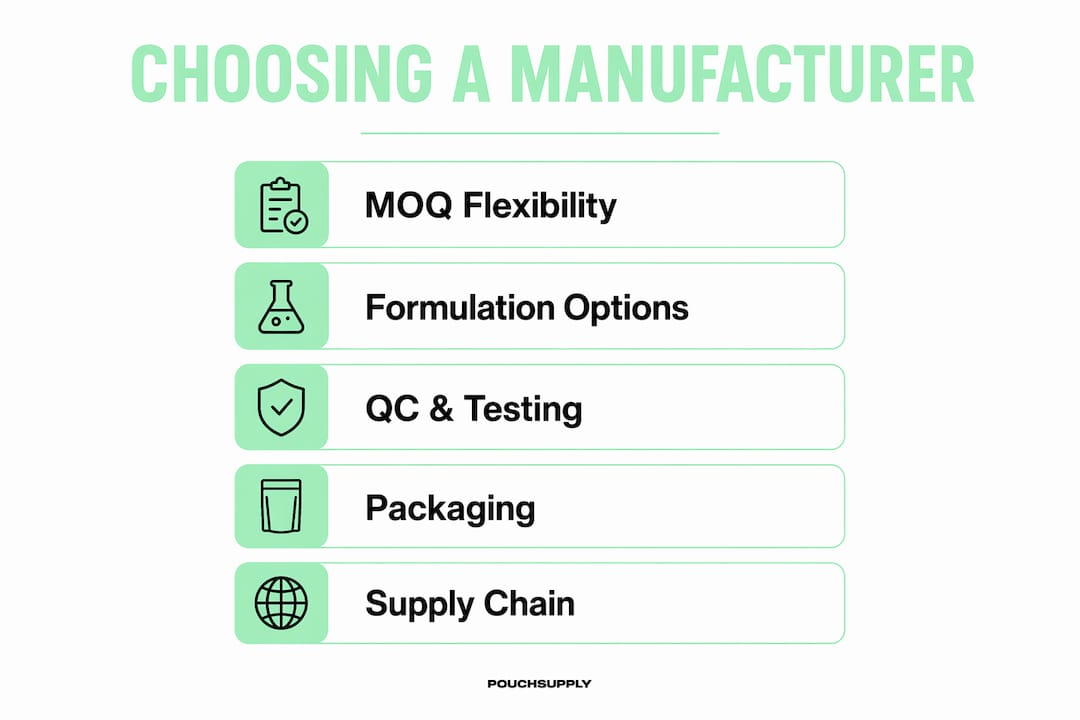
1. MOQ flexibility. Can they split an order across multiple SKUs? Do they allow sample runs before a commercial commitment? A supplier who won’t split SKUs or provide samples is a red flag for small-batch buyers.
2. Formulation options. Do they offer both pre-formulated and custom routes? Can they handle nicotine salts, freebase, and functional ingredients like caffeine or L-theanine? Narrow formulation capability limits your product roadmap.

3. QC and lab testing. Ask specifically: what QC checks happen between sample approval and commercial production? Vague answers (“we test everything”) without specifics on nicotine potency verification, microbial screening, or batch-to-batch consistency checks are warning signs. Clear documentation — COA, MSDS, batch records — is the fastest way to separate reliable partners from risky ones.
4. Packaging capabilities. Can they handle your label format, can size, and any market-specific warning requirements? Packaging delays are one of the most common reasons commercial timelines slip.
5. Supply chain transparency. Where do their raw materials come from? Can they provide ingredient sourcing documentation? This matters for U.S. import compliance and for any retailer audit you’ll face later.
Red flags to watch for: COAs with no batch numbers, no willingness to split SKUs, inability to name the lab that ran their testing, and vague answers on lead times.
A realistic low-MOQ project moves through these stages:
Cost components to budget for:
SKU splitting affects unit economics directly. Splitting a large order across multiple flavors raises per-unit cost compared to a single SKU run, because of line changeovers and smaller per-flavor batch sizes. The tradeoff is worth it when you’re testing market response across flavors before committing to a larger run.
The FDA’s Center for Tobacco Products oversees e-liquid manufacturing and marketing in the United States under the Tobacco Control Act. Any e-liquid containing nicotine is subject to premarket authorization requirements, and the regulatory burden sits with the brand owner, not the contract manufacturer.
What to request from every manufacturer: A Certificate of Analysis confirming nicotine potency and purity, an MSDS/SDS for each formulation, batch QC records showing consistency between the approved sample and the commercial run, a Certificate of Conformity, and sanitary declarations where applicable. For U.S. import, also ask about heavy metals testing and residual solvent screening.
Reputable manufacturers can supply these documents as part of their standard service. Quality certification approaches used across the industry — including ISO-aligned manufacturing standards and third-party lab verification — give U.S. buyers a useful benchmark when evaluating overseas suppliers.
This article is general information, not legal or regulatory advice. Confirm current FDA requirements with qualified legal counsel before launching any nicotine-containing product in the United States.
Pouchsupply operates as a full-service white-label and contract manufacturer covering nicotine pouches, caffeine pouches, nootropic pouches, and custom vape liquids. The production capacity runs up to one million cans per month, which means a brand that starts with a low-MOQ run has a clear path to scale without switching partners.
Capability highlights:
| SKU Split | Cans per SKU | Total Order |
|---|---|---|
| 1 SKU | 7,200 | 7,200 |
| 2 SKUs | 7,200 | 7,200 |
| 3 SKUs | 2,400 | 7,200 |
The SKU-split structure is particularly useful for brands entering a new market with multiple flavor concepts. You test three flavors at 2,400 cans each, identify the winner, and scale that SKU on the next run.
A well-prepared brief cuts your back-and-forth in half. Send this information with your first inquiry:
Questions to ask on your first supplier call:
Attach a one-page spec sheet and your estimated launch calendar to your initial inquiry. Suppliers who respond with specific answers to your brief are worth pursuing; those who respond with generic pricing sheets before reading your requirements rarely deliver well on custom or split-SKU orders. The white-label e-liquid workflow guide on Pouchsupply’s blog covers additional considerations for first-time brand orders.
Finding the right low-MOQ e-liquid manufacturer comes down to confirming MOQ terms per SKU, insisting on full documentation, and testing across the device formats your customers actually use.
| Point | Details |
|---|---|
| MOQ depends on product type | White-label pre-formulated SKUs can start at 24–50 units per SKU; custom formulations typically require 25 kg per SKU; custom flavor concentrates typically require 10 kg per SKU. |
| SKU splitting changes unit economics | Splitting an order across multiple flavors reduces per-SKU inventory risk but raises per-unit cost. |
| Documentation is your quality filter | Insist on COA, MSDS, batch QC records, and Certificate of Conformity before committing to any commercial run. |
| Device testing prevents launch failures | Test across mods, pods, and disposables — a formula that works in one device class can underperform in another. |
| Pouchsupply offers 7,200-can MOQ | Orders split across multiple SKUs with sample development in a few weeks and large production capacity. |
The pattern we see most often: a brand leads with price and treats documentation as an afterthought. They find a supplier offering a compelling per-unit rate, place a small order, and discover after the fact that the COA is generic, the batch QC records don’t exist, and the nicotine potency hasn’t been independently verified. By then, they’ve already designed packaging and set a launch date.
The second mistake is under-testing across device classes. A brand will approve a sample on the device they personally use, then ship product to retail accounts stocking a completely different pod system. The flavor doesn’t translate, and the first batch becomes a write-off.
The corrective action is simple: before you approve any sample for commercial production, run it through every device format your distribution channel carries. And before you sign any manufacturing agreement, ask for a sample COA with a real batch number and the name of the third-party lab. If the supplier can’t produce that, the low MOQ isn’t worth the risk.
Brands that need a manufacturing partner covering both vape liquids and functional pouches under one roof get a real operational advantage with Pouchsupply. You avoid the complexity of managing separate suppliers for your nicotine pouch line and your e-liquid SKUs, and you work with a single documentation and QC workflow across both product categories.

Pouchsupply’s standard entry point is 7,200 cans per order, splittable across up to three SKUs, with nicotine pouch manufacturing and nootropic and functional pouch production available alongside custom vape liquid development. Sample development runs 1–4 weeks, commercial production takes up to 30 days, and full documentation support is included as standard.
To get started, send a product brief covering your target format, desired ingredients, flavor direction, and estimated order volume. The team will respond with a realistic quote and timeline. Reach out directly at pouchsupply.eu to request a quote.