Nicotine salts are protonated nicotine formed by combining freebase nicotine with an organic acid, and that single chemical change drives nearly every practical difference you’ll notice when vaping. Freebase nicotine sits at a pH of roughly 8–10, making it alkaline and noticeably harsh at high concentrations. Salts drop that pH to around 5.5–6.0, bringing it closer to physiological levels and allowing much higher nicotine concentrations to be inhaled comfortably. The short version: use salts in low-wattage pod systems and disposables; use freebase in sub-ohm, high-wattage direct-lung setups.
At a glance:
Freebase nicotine is the unprotonated form of the molecule. It’s what cigarette manufacturers have used since the 1960s, when Philip Morris discovered that freeing nicotine from its natural salt state made it more volatile and faster-absorbing. In that free form, the pyrrolidine nitrogen carries no charge, the molecule is lipophilic, and it crosses cell membranes readily — but it’s also alkaline and irritating to mucous membranes at concentrations above roughly 6 mg/mL.
Nicotine salts are created by adding an organic acid to freebase nicotine. The acid protonates the pyrrolidine nitrogen, forming a salt compound. This lowers the pH of the e-liquid and reduces the alkalinity that causes throat irritation. The most common acids used are:
The acid choice and molar ratio both matter. A 1:1 molar ratio of nicotine to benzoic acid produces a different sensory result than a 0.5:1 ratio, and switching from benzoic to lactic changes both the absorption profile and the flavor character of the finished liquid.
Pro Tip: When selecting an acid for a salt formulation, consider the delivery goal first. Benzoic acid favors rapid nicotine onset; lactic acid trades some speed for a softer mouthfeel. Matching the acid to the intended user experience before locking in a formula saves costly reformulation later.
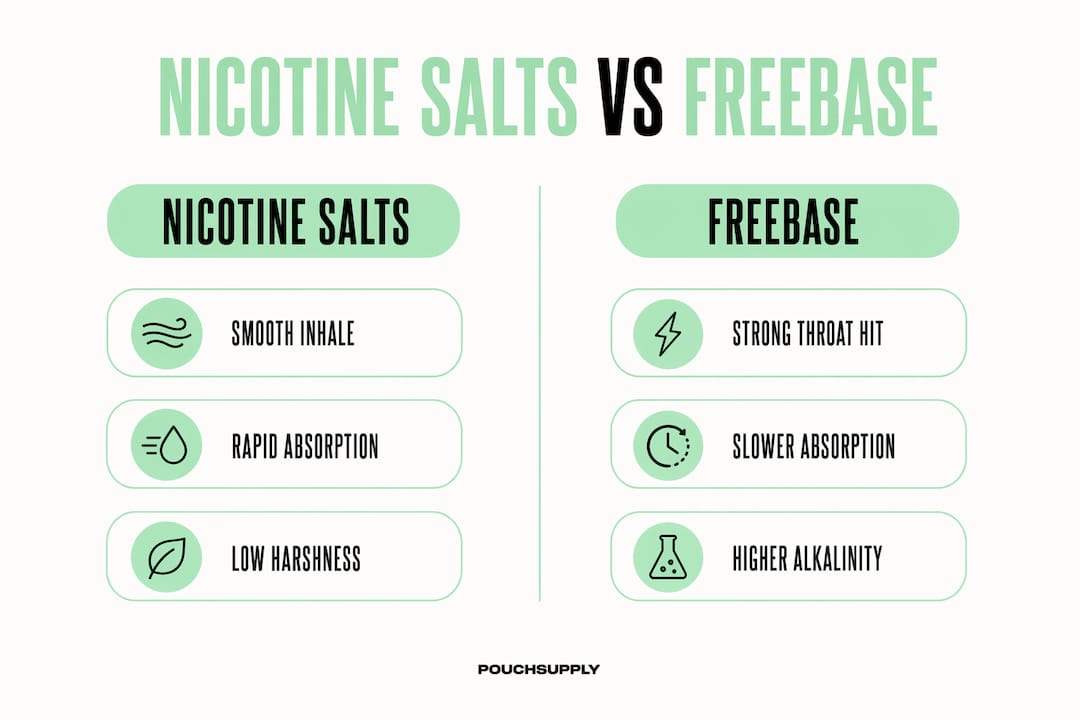
The pH difference translates directly into what you feel on the inhale. Freebase nicotine at high concentrations produces a sharp, scratchy throat hit that most people find unpleasant above 12 mg/mL. By contrast, salts at concentrations typically between 20 and 50 mg/mL feel noticeably smoother because the protonated molecule is less irritating to airway tissue.
A JAMA Network Open randomized clinical trial with 119 participants found that salt vs freebase formulations produced significantly higher ratings for appeal, sweetness, and smoothness, and significantly lower ratings for bitterness and harshness. The smoothness-enhancing effect was actually stronger in people who had never smoked cigarettes — which matters for understanding why salt-based products attracted a younger, non-smoking audience.
Key clinical finding: In the JAMA Network Open trial, salt nicotine formulations produced a mean smoothness rating 17.4 points higher than freebase (95% CI, 15.2–19.6; P < .001), with harshness ratings 21.0 points lower (95% CI, 23.2–18.7; P < .001) at matched nicotine concentrations averaging 23.6 mg/mL.
On absorption, the picture is more nuanced. Protonated nicotine tends to produce higher and faster plasma nicotine peaks in low-wattage pod devices. In high-wattage direct-lung setups, freebase can be more efficient because aerosol density and evaporation behavior in those conditions favor freebase transfer into airway tissue.
The behavioral risk is real: because salts feel smooth, users often inhale more deeply and more frequently without the sensory feedback that would otherwise signal “enough.” High-strength salt products can build tolerance faster than equivalent freebase products at lower concentrations.

Device choice is where the nicotine salts vs freebase decision becomes non-negotiable. The device-form pairing isn’t just a preference — it’s a safety and performance issue.

| Device type | Resistance | Wattage | Recommended nicotine form | Typical use style |
|---|---|---|---|---|
| Pod system / closed pod | High (sub-ohm) | Low (8–15W) | Nicotine salts | Mouth-to-lung (MTL) |
| MTL tank / starter kit | Medium (MTL coil range) | Low-medium (10–20W) | Salts or low-mg freebase | Mouth-to-lung |
| Sub-ohm tank / RDA | Low (sub-ohm) | High (high-wattage) | Freebase nicotine | Direct-lung (DTL) |
| Disposable bar | High (fixed coil) | Low (fixed) | Nicotine salts | Mouth-to-lung |
Do not use high-mg salt nicotine in a sub-ohm device. A 50 mg/mL salt liquid in a 60W sub-ohm setup can deliver a nicotine dose in seconds that would take many puffs from a pod to match. The result is nausea, dizziness, and potential nicotine toxicity — not just discomfort.
Setup tips by nicotine form:
Pro Tip: If you’re building a product line for both pod and sub-ohm users, formulate two separate SKUs rather than trying to find a middle-ground concentration. A 20 mg/mL salt for the pod SKU and a 6 mg/mL freebase for the sub-ohm SKU will satisfy both audiences far better than a single compromise formula.
Salts are commonly sold at higher nicotine concentrations in pod and disposable formats compared to freebase liquids, which are typically formulated at lower concentrations for sub-ohm and mouth-to-lung devices. The mg/mL figure indicates the amount of nicotine per milliliter of liquid, regardless of form.
Converting mg/mL to percentage:
The same mg/mL delivers the same mass of nicotine regardless of form, but perceived strength differs. Salts at 20 mg/mL feel milder than freebase at 20 mg/mL because the reduced harshness changes how deeply and how often you inhale. That’s why choosing the right nicotine strength for your device and habit matters more than the number on the label alone.
Dosing guidance: If you’re switching from cigarettes to a pod system, starting at 20 mg/mL salt is a common entry point. If you’re moving to sub-ohm, start at 3–6 mg/mL freebase. Never transfer a salt concentration directly to a high-wattage device.
Practical starting points:
The clinical evidence on salts vs freebase vaping is still developing, but several findings are consistent enough to take seriously.
The JAMA Network Open trial confirmed that salt formulations increase product appeal, particularly among non-smokers. That’s a public health concern as much as a product feature: smoother, more appealing products can attract people who would not otherwise use nicotine. Some laboratory and preclinical work has also flagged potential epithelial and inflammatory responses linked to certain salt-form aerosols, though long-term human data remain limited.
What the science currently supports: Nicotine salt formulations consistently reduce harshness and increase appeal compared to freebase at matched concentrations. Whether that translates to greater long-term addiction risk or respiratory harm requires further independent clinical study with standardized conditions.
Key safety considerations:
Risk-mitigation steps for users and product developers:
This article is general information, not medical or cessation advice. Consult a healthcare professional for questions about nicotine dependence or quitting.
The decision comes down to three variables: your device, your nicotine history, and what you want from the experience.
Decision map:
Questions to ask yourself before buying:
Red flags to watch for:
Common scenarios:
From a formulation standpoint, the salt vs freebase choice is just the beginning. Acid selection, molar ratio, base liquid composition, and analytical method all need to align before a product is ready for commercial production.
Acid selection and sensory trade-offs:
QC and analytical requirements:
| Parameter | Freebase method | Salt method |
|---|---|---|
| Nicotine purity assay | GC-FID | HPLC or titration (accounts for acid component) |
| pH verification | Standard pH meter | Required at each batch |
| Stability testing | Accelerated heat/light | Same, plus acid degradation monitoring |
| Batch homogeneity | Concentration uniformity | Concentration + acid ratio uniformity |
Nicotine salts can show different degradation pathways under heat and light compared to freebase. Under normal storage conditions, salts are often less prone to oxidation, but stability depends on the specific formulation and packaging. Amber glass or opaque HDPE containers, stored below 25°C and away from direct light, are standard for both forms.
U.S. market labeling and regulatory reminders:
For brands building a white-label nicotine pouch or custom vape liquid line, Pouchsupply provides formulation development, Certificate of Analysis, Material Safety Data Sheets, and Certificate of Conformity as part of its standard manufacturing process. Understanding the snus vs vape product landscape also helps brand owners position their nicotine form choice within a broader portfolio strategy.
Temperature is one of the most underappreciated variables in the salts vs freebase vaping comparison. Both forms are delivered as aerosol, but the coil temperature, device power, and airflow path all influence how much nicotine actually reaches the user’s bloodstream.
Freebase nicotine has a lower boiling point than its salt counterparts, which means it vaporizes more readily at lower coil temperatures. In a high-wattage sub-ohm device running at 60–80W, the coil reaches temperatures where freebase transfers efficiently into the aerosol. Salt forms, with their higher molecular weight from the added acid, require slightly more energy to vaporize fully. At low wattage (8–15W in a pod), that difference is negligible. At high wattage, it becomes meaningful: salts may not fully vaporize, leaving residue on the coil and reducing delivery efficiency.
Mouth-to-lung (MTL) vaping involves a cooler, tighter draw that keeps aerosol in the mouth briefly before inhalation. This suits salt nicotine because the slower, cooler delivery matches the lower-wattage coil and gives the protonated nicotine time to absorb across oral and upper-airway mucosa. Direct-lung (DTL) vaping pushes a large, warm aerosol bolus directly into the lungs, where the large surface area and buffering capacity of lung fluid mean pH differences matter less. That’s partly why freebase can be effective in DTL conditions despite its alkalinity.
Vaporization method also interacts with PG/VG ratio. Higher VG liquids produce denser, cooler aerosol at the same wattage. Pairing a high-VG freebase liquid with a sub-ohm device and open airflow is the standard cloud-chasing setup for good reason: it maximizes aerosol volume while keeping nicotine concentration low enough to avoid harshness. Salts in a high-PG base in a pod system produce a tighter, warmer draw that mimics the feel of a cigarette more closely.
Nicotine salts deliver a smoother, higher-concentration experience suited to pod devices, while freebase nicotine performs better in sub-ohm setups and more closely replicates the throat hit of a cigarette.
| Point | Details |
|---|---|
| pH drives the core difference | Salts lower e-liquid pH to ~5.5–6.0 vs freebase at ~8–10, reducing harshness at high concentrations. |
| Device match is non-negotiable | Use salts in low-wattage pods and disposables; use freebase in sub-ohm, high-wattage direct-lung devices. |
| Concentration ranges differ significantly | Salts are most often used at 20–50 mg/mL concentrations, while freebase liquids for sub-ohm devices are typically formulated at 3–6 mg/mL. Never transfer a salt concentration to a high-wattage device. |
| Smoothness increases intake risk | Salts remove the harshness cue that limits consumption; users can unknowingly exceed their intended nicotine dose. |
| Acid choice shapes the product | Benzoic acid favors fast delivery; lactic acid softens mouthfeel. Manufacturers must validate assay methods separately for each form. |
Final warning: High-strength salt nicotine in a high-wattage device is not a minor inconvenience. It’s a fast route to nicotine toxicity. Always check the label for device compatibility and start at the lowest effective concentration.
The conversation around nicotine salts vs freebase tends to get flattened into “salts are smoother, freebase is harsher” — and that’s technically true but practically incomplete. What gets missed is that the acid choice, the molar ratio, and the device all interact. A lactic acid salt at 20 mg/mL in a 10W pod is a very different product from a benzoic acid salt at 50 mg/mL in the same device. Treating “salt nicotine” as a single category is like treating “freebase at any concentration” as a single experience.
The clinical evidence from JAMA Network Open is worth taking seriously, not just for the smoothness finding but for the implication: a product that removes the sensory deterrent to inhalation will be used differently than one that doesn’t. That’s a formulation decision with real downstream consequences for the user, and it’s one that product developers should own explicitly rather than treat as a marketing feature.
For brands building in this space, the practical takeaway is to design the product around the device and the user’s nicotine history, not around the highest concentration the formulation can support. Pouchsupply works with brand owners on exactly this kind of formulation strategy, from acid selection and stability testing through to regulatory documentation. If you’re developing a custom vape liquid or nicotine pouch line, the formulation decisions made at the start determine everything that follows.
Nicotine forms: why and how do they matter in nicotine delivery from electronic cigarettes? (PMC) — Comprehensive review of protonated vs freebase nicotine absorption, sensory effects, and analytical approaches; primary reference for the chemistry and pharmacokinetics sections.
Effect of Exposure to e-Cigarettes With Salt vs Free-Base Nicotine on the Appeal and Sensory Experience of Vaping: A Randomized Clinical Trial (JAMA Network Open) — Randomized clinical trial (n=119) confirming salts produce higher appeal, smoothness, and lower harshness than freebase at matched concentrations.
Dose Response Effects of Two Nicotine Salt Formulations on Electronic Cigarette Appeal and Sensory Attributes (PMC) — Within-subject dose-response experiment comparing benzoic and lactic acid salts to freebase; supports pH and protonation claims.
Aerosol physics and nicotine transfer in electronic cigarettes (PMC) — Covers how device power and aerosol physics influence nicotine transfer efficiency for both nicotine forms.
Nicotine vaping products analysis and evidence — University of Wollongong, via TGA — Regulatory evidence review covering acid types, formulation behavior, and sensory differences; used for acid-selection guidance.
Nicotine Salts vs. Freebase Nicotine: A Complete Comparison (NicAlliance) — Industry overview of concentration ranges, stability considerations, and analytical method differences between salt and freebase forms.
UK vape regulations: What You Need to Know — Jurisdictional overview of vape device and nicotine restrictions; useful context for brands navigating regulatory requirements across markets.
PouchSupply: white-label nicotine pouch and custom vape liquid manufacturing — Manufacturer resource for brands developing salt or freebase vape liquids and nicotine pouch products, including formulation, QC, and regulatory documentation support.