Nicotine pouches are legal to buy, sell, and carry in the UK — but as of 2026, they are no longer a grey-area consumer product. The Tobacco and Vapes Act 2026 formally reclassified them as regulated “nicotine products,” bringing them under the same legal framework that governs vapes and tobacco. The headline change: selling to anyone under the legal minimum age is now a criminal offense, free sampling is banned, and ministers hold enabling powers to cap nicotine strength, restrict flavors, and mandate plain packaging through secondary legislation expected through late 2026 and into 2027.
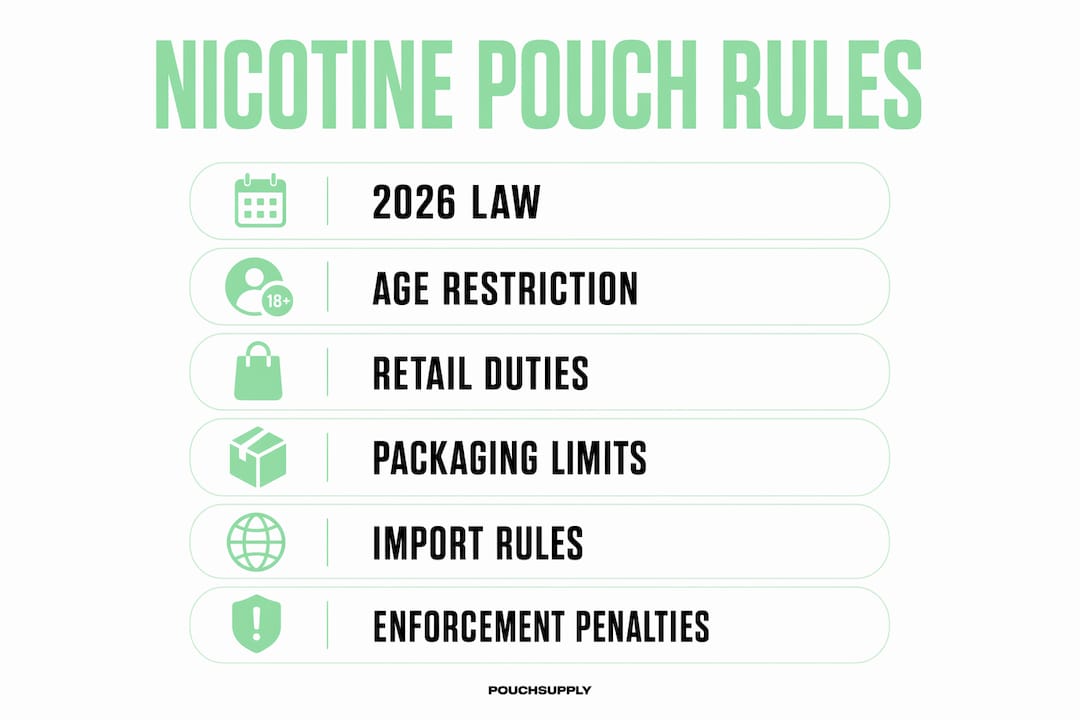
Quick-reference summary:
Before 2026, nicotine pouches sat in a regulatory gap. They were treated as general consumer products under the General Product Safety Regulations, which meant no legal nicotine cap and no statutory minimum age of sale. Products on the UK market ranged widely in nicotine content per pouch, a spread that drew sharp criticism from public-health groups and parliamentary committees alike.
The Tobacco and Vapes Act 2026, which received Royal Assent on April 29, 2026, ended that. The Act’s definition of “nicotine product” is deliberately broad, written to capture not just pouches but any future nicotine delivery format that isn’t a vape, tobacco product, or licensed medicine. That future-proofing language matters: dissolvable strips, nicotine gels, and similar formats will likely fall under the same rules unless ministers specifically carve them out.
What the Act switches on immediately or by statutory date:
What requires secondary legislation (expected late 2026–2027):
The distinction between “immediate provisions” and “enabling powers” is the most important thing businesses need to understand. The Act is the skeleton; secondary statutory instruments will add the operational detail. Manufacturers and retailers who treat October 2026 as the only compliance deadline are underestimating the timeline.
The age-of-sale rule is now statutory and unambiguous: selling a nicotine product to anyone under 18 is a criminal offense under Section 10 of the Act, carrying a fine up to Level 4 on the standard scale (currently £2,500). The same applies to proxy purchases — an adult buying on behalf of a minor commits a separate offense under Section 11.
| Obligation | In-store | Online |
|---|---|---|
| Age verification | ID check at point of sale | Robust age-gate and verification system |
| Free sampling | Banned entirely | Banned entirely |
| Vending machines | Prohibited | N/A |
| Proxy purchase liability | Staff training required | Platform-level controls needed |
| Record-keeping | Document refusals and check policies | Audit logs for age-verification system |

Online sellers face a higher practical burden. A simple date-of-birth field does not meet the “all reasonable steps” defense the Act requires. Age verification services that cross-reference credit data or government ID databases are the direction of travel, consistent with how vape retailers have already adapted.
Compliance checklist for retailers:
Some major retailers had already introduced voluntary age checks and strength limits before the Act passed. That head start matters: Trading Standards enforcement typically focuses first on businesses with no documented compliance process at all.
Business-to-business sales and trade samples occupy a different position. The Act’s age-of-sale provisions target retail sales to consumers. B2B transactions between manufacturers and registered distributors are not the same as retail, but the free-distribution ban applies broadly — check the specific wording of secondary regulations as they are issued before assuming B2B sampling is permitted.
The Act gives ministers broad powers over product standards, but most of those powers are not yet exercised. What is already in force: the free-sample ban and the framework for advertising restrictions. What is coming: the operational detail.
Advertising and sponsorship. The Act grants powers to ban advertising and sponsorship of nicotine products across all channels, with staggered effective dates tied to secondary regulations. Digital advertising, out-of-home placements, influencer partnerships, and event sponsorships are all within scope. Brands running any of these channels should treat them as high-risk and begin winding down campaigns that could not survive a full advertising ban.
Nicotine strength. No legal cap exists yet, but industry bodies and manufacturers have been using a de facto 20mg-per-pouch guideline that mirrors the limit applied to e-liquids. Parliamentary records documented products on the UK market ranging from 2mg to 150mg+ per pouch, which is precisely the evidence base ministers will use when setting a cap. Brands selling above 20mg face the highest reformulation risk. The low-harm nicotine product framing that DHSC favors points toward a cap in that range.
Flavors and packaging. DHSC has consistently framed pouches as a cessation aid for adult smokers, not a lifestyle product. That framing signals that youth-appealing flavor names and branding styles are likely targets for restriction. Plain packaging powers are included in the Act; whether ministers exercise them for pouches specifically will depend on evidence gathered during the secondary-regulation consultation process.
What to prepare now:
Pro Tip: Design your packaging in modular layers — a base structure that meets likely plain-pack requirements, with brand elements applied separately. If restrictions land, you adapt the outer layer without scrapping the full print run.
For travelers, the short answer is straightforward: nicotine pouches are permitted in both hand luggage and checked baggage on flights into the UK. There is no specific personal import allowance for pouches the way there is for tobacco or alcohol, because they are not a tobacco product. Carry them in their original manufacturer packaging with labeling intact — that is the clearest way to demonstrate they are a personal-use consumer product rather than a commercial shipment.

Commercial imports are a different matter entirely and require proper documentation.
Step-by-step checklist for commercial importers:
One point travelers often miss: the UK’s permissive stance on pouches does not mean every country you transit through or travel to shares it. Several countries have outright bans on nicotine pouches, including some EU member states and parts of Asia. Check the destination country’s rules before packing, and check transit country rules if you have a layover with a bag recheck.
Trading Standards officers at local authority level are the primary enforcement body for age-of-sale and distribution offenses. The Act also names relevant enforcement authorities in England with powers to issue fixed penalty notices for specific offenses, including the age-of-sale violation, proxy purchase, and free-distribution breaches.
Penalty structure under the Act:
Repeat or deliberate breaches carry greater risk than a single fine. The Act’s retail licensing framework means that serious or persistent violations could affect a retailer’s ability to hold a license to sell regulated products at all. That escalation path is what makes early compliance worth the investment.
Independent retailers face the sharpest practical challenge. Large supermarket chains have compliance infrastructure and legal teams that can absorb regulatory change quickly. A small convenience store owner needs to update staff training, revise point-of-sale materials, and potentially change supplier relationships — all before October 29, 2026. The voluntary measures some major retailers had already adopted before the Act passed give a useful benchmark for what “reasonable steps” looks like in practice.
Immediate compliance priorities for retailers:
The Tobacco and Vapes Act 2026 creates a compliance baseline, but secondary regulations will determine the operational detail. Brands that treat this as a one-time compliance event will find themselves reformulating, relabeling, and reprinting packaging multiple times through 2027. The smarter approach is to build flexibility into every product and packaging decision now.
Step-by-step action plan for manufacturers and brands:
What to look for in a white-label manufacturing partner:
Pro Tip: Order smaller initial runs of any SKU above 20mg until the strength cap is confirmed. The cost of a shorter run is far lower than the cost of stranded inventory if a cap lands below your current formulation.
Transitional arrangements for existing stock are not yet formally defined in the Act’s primary text. The practical guidance is to manage stock levels conservatively for high-strength products and to have reformulated alternatives ready to ship before secondary regulations take effect. Brands that have already moved toward a 20mg target, as some manufacturers did voluntarily before the Act passed, are in the strongest position.
For more on building a compliant product from the ground up, launching your own nicotine pouch brand requires exactly the kind of documentation and formulation flexibility the new rules demand.
The Tobacco and Vapes Act 2026 keeps nicotine pouches legal for UK adults while creating a structured compliance framework that will tighten through secondary legislation in late 2026 and 2027.
| Point | Details |
|---|---|
| Legal status | Nicotine pouches are legal for adults in the UK under the Tobacco and Vapes Act 2026. |
| Age-of-sale deadline | Selling to anyone under 18 is a criminal offense from October 29, 2026. |
| Immediate bans | Free sampling and vending machine sales are prohibited under the Act now. |
| Secondary regulations | Strength caps, flavor limits, and packaging rules are coming via secondary legislation through 2027. |
| Pouchsupply’s role | Pouchsupply provides white-label manufacturing with COA, SDS, flexible formulations, and packaging support for UK-bound products. |
The move from “general consumer product” to “regulated nicotine product” is not just a UK compliance story. It is a signal about where nicotine pouch regulation is heading globally, and U.S. brands exporting to the UK need to treat it as such.
The practical implication for exporters is not just paperwork. It is a fundamental change in how you position and document your product. A pouch that was sold into the UK as a lifestyle product with bold branding and a 30mg nicotine content is now a product that needs a technical file, age-gated distribution, and a reformulation roadmap. The market access is still there for compliant operators. The grey area is not.
For U.S. travelers, the rules are simpler: carry your pouches in original packaging, keep quantities clearly personal-use scale, and be prepared to show ID if a retailer asks. The more important check is your destination. The UK permits pouches; several countries you might transit through or visit do not. Checking destination rules before you pack is not overcaution — it is the difference between a smooth trip and a customs seizure.
The broader strategic point for U.S. manufacturers: the UK’s approach, regulating rather than banning, with enabling powers for future tightening, is likely to be the template other markets follow. Brands that build compliance infrastructure now, flexible formulations, modular packaging, full technical documentation, are not just solving a UK problem. They are building the operational capability that every regulated market will eventually require. The nicotine regulation landscape in 2026 is moving fast, and the brands that adapt early will find market entry easier, not harder, as rules spread.
Entering the UK market under the new regulatory framework means your product needs more than a good formulation. It needs documentation, flexible packaging, and a manufacturing partner who can adapt when secondary regulations land.

Pouchsupply’s white-label nicotine pouch manufacturing is built for exactly this situation. Every commercial batch ships with a Certificate of Analysis and Safety Data Sheet as standard. Formulations can be adjusted to target a 20mg nicotine content without restarting product development from scratch. Packaging is designed in configurable formats so that plain-pack or restricted-branding requirements can be accommodated without scrapping full print runs. Batch traceability is documented from raw ingredient to finished can, and recall procedures are in place.
The process starts with a consultation where you define your target market, strength, flavor profile, and packaging requirements. Sample development typically takes one to four weeks. From there, Pouchsupply handles formulation, packaging, documentation, and production, with capacity up to one million cans per month for brands scaling quickly. Minimum orders start at 7,200 cans, divisible across up to three SKUs.
To get started, request a consultation and bring your UK market brief. The earlier you engage, the more flexibility you have before secondary regulations set the final rules.
Regulations in this area are moving fast. Secondary statutory instruments will add the operational detail that the Act’s enabling powers leave open. Monitor these primary sources directly:
Secondary regulations will be published on legislation.gov.uk as statutory instruments. Set a gov.uk alert for “nicotine products regulations” to catch flavor, strength, and packaging rules as they are laid before Parliament.
This article provides general information about UK nicotine product regulations and is not legal advice. Confirm current rules with gov.uk, a qualified legal professional, or a regulatory consultant before making compliance decisions for your specific situation.