White label products are generic goods manufactured by one supplier and sold under many different brand names, while private label products are custom-made exclusively for a single brand. That distinction shapes everything: your upfront costs, your timeline to market, your profit margins, and how defensible your brand becomes over time. Entrepreneurs choosing between these two models are really choosing between speed and differentiation. Understanding the white label definition and how it contrasts with private label manufacturing is the first step toward a sound product strategy.
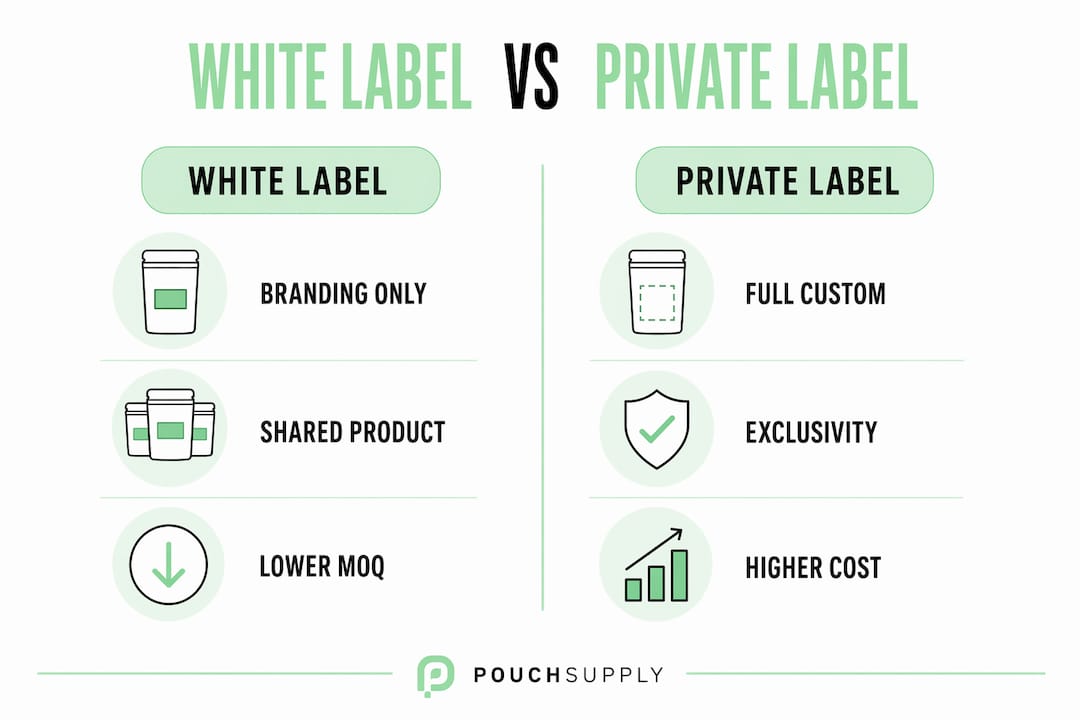
The core difference between white label and private label comes down to customization and exclusivity. White label products use a single manufacturer’s formula or design, which any number of brands can purchase and rebrand. Private label goods are developed to a specific brand’s requirements and sold exclusively by that brand.
This distinction creates a cascade of practical differences across four dimensions:
Customization scope: White label branding is limited to packaging, logo, and color. Private label allows you to define the formula, ingredients, flavor profile, texture, and packaging from the ground up.
Exclusivity: White label products carry no exclusivity. Your competitor can sell the identical product under their own label tomorrow. Private label products belong to your brand alone, giving you a real competitive edge.
Cost and minimum order quantities (MOQs): White label MOQs typically start at 100–500 units with low upfront investment. Private label MOQs often range from 500 to 3,000 or more units, with additional development costs layered on top.
Timeline: A white label product can reach shelves in weeks. Private label development runs from several months to a full year, depending on product complexity and required testing.
Intellectual property: White label gives you no ownership over the product itself. Private label transfers product specifications and, in many cases, formulation rights to your brand.
The table below maps these differences side by side:
| Category | White label | Private label |
|---|---|---|
| Customization | Branding only | Full product design |
| Exclusivity | Shared with competitors | Exclusive to one brand |
| MOQ | 100–500 units | 500–3,000+ units |
| Time to market | Weeks | Several months to a year |
| IP ownership | None | Partial to full |
| Margin potential | Lower (commodity pricing) | Higher (brand premium) |
Every entrepreneur needs to weigh these models against their actual resources and goals, not an idealized version of either.
White label products get you to market fast with minimal financial exposure. You skip product development entirely, which means no R&D costs, no formulation testing, and no lengthy approval cycles. This makes white label the right tool for market testing. If you want to know whether customers will buy a nicotine pouch in a specific flavor before committing to a custom formula, white label gives you that answer cheaply.

White label also carries lower operational risk. You are selling a product that already works, already meets basic quality standards, and already has a manufacturing process behind it. That reduces the chance of a costly product failure early in your business.
The lack of exclusivity is the defining weakness of white label. White label listings are vulnerable to price undercutting and, on platforms like Amazon, to ASIN hijacking where other sellers attach to your listing. Without a unique product, your only competitive lever is price. That leads to margin erosion fast.
White label also limits brand storytelling. You cannot credibly claim a proprietary formula or a unique product experience because the same product exists under other names.
Private label products support higher long-term margins because your product is not a commodity. Customers cannot find the identical item elsewhere, which means price comparisons become less direct. Private label also enables enrollment in Amazon Brand Registry, which requires a registered trademark and exclusive product listings. That protection matters enormously on high-traffic marketplaces.
Private label builds brand equity. Over time, customers associate the product experience with your brand specifically, not with a generic category.
The upfront investment is significantly higher. Budget 10–20% more initially for compliance, certification, and safety testing that white label suppliers typically handle for you with pre-certified goods. Development timelines are longer, and any modification to the product formula may trigger fresh compliance testing, adding both cost and delay.
Pro Tip: Start with white label to test demand in a new category. Once you have sales data proving the market exists, use that evidence to justify the higher investment in a private label version.
The right choice depends on where your business is right now, not where you hope it will be in three years.
Choose white label when:
Choose private label when:
Many entrepreneurs treat these models as mutually exclusive. They are not. A hybrid approach works well: launch a white label product to generate revenue and gather customer feedback, then use that data to fund and inform a private label development cycle. White label suits startups testing markets with lower financial risk, while private label suits established brands aiming for differentiation and loyalty through unique products.
Pro Tip: If you are selling on Amazon, the difference between white label and private label becomes a brand protection issue. Private label gives you the trademark control needed for Brand Registry, which is your primary defense against listing hijackers.
The competitive landscape of your category also matters. In a market where dozens of sellers offer the same white label product, margins compress quickly. If the category you are entering already shows signs of price wars, private label is worth the extra investment from the start.
Entrepreneurs often use white label to validate market demand with minimal upfront capital, then transition to private label once demand is proven. That transition is a major milestone, and it requires preparation across several fronts.
Key considerations before making the move:
Transitioning from white to private label creates a defensible market position through intellectual property and product uniqueness. That defensibility is the payoff for the higher investment and longer timeline.
Private label builds defensible brand equity and higher margins, but white label remains the fastest and lowest-risk way to enter a new market and validate demand.
| Point | Details |
|---|---|
| White label is fast and low-cost | MOQs start at 100–500 units with weeks-to-market timelines, ideal for early testing. |
| Private label creates exclusivity | Custom formulations owned by your brand prevent direct price competition. |
| Compliance costs more in private label | Budget 10–20% more upfront for certification and safety testing. |
| Hybrid strategies work well | Launch white label to validate demand, then fund private label development with early revenue. |
| Manufacturer selection is critical | Private label requires a long-term manufacturing partner with proven quality control and scaling capacity. |
Most entrepreneurs frame this as a permanent choice. It is not. After working with brands across the nicotine pouch and functional product categories, the pattern I see most often is this: the brands that succeed long-term almost always start with white label and move to private label once they have real market evidence.
The mistake I see repeatedly is overinvesting in private label before the market has spoken. Founders spend months developing a custom formula, budget heavily on compliance, and launch into a market they have not yet tested. When sales disappoint, they have little capital left to pivot. White label removes that risk. It lets you learn what customers actually want before you commit to a specific product design.
The other mistake is staying in white label too long. Once you have consistent sales and a clear customer base, the commodity pricing trap becomes a real threat. Competitors will undercut you because they can. Private label is how you escape that trap. It gives you a product story, a trademark, and a reason for customers to choose you specifically.
The best manufacturers understand both models and can support you through the transition. That is not a small thing. A supplier who only does white label cannot help you build the custom formulation and compliance documentation you need for private label. Choose your manufacturing partner with the full arc of your brand in mind, not just your immediate launch needs.
— Martins
Pouchsupply works with entrepreneurs at every stage, from first-time founders testing a product concept to established brands building proprietary formulations.

For brands entering the nicotine pouch or nootropic pouch category, Pouchsupply offers both white label and private label manufacturing under one roof. White label options let you launch quickly with proven formulations across a range of flavors and nicotine strengths. Private label development gives you full control over your formula, packaging, and product specifications, with Pouchsupply managing regulatory compliance throughout the process. The team handles everything from product development to finished packaging, so you can focus on building your brand rather than managing production logistics. If you are ready to move from concept to shelf, Pouchsupply is built for exactly that transition.
White label products are generic goods sold under multiple brand names, while private label goods are custom-made exclusively for one brand. The key distinction is exclusivity and the level of product customization.
White label manufacturing requires lower upfront investment, with MOQs typically starting at 100–500 units and no product development costs. Private label requires higher capital for custom formulation, compliance, and larger minimum orders.
Yes. Many entrepreneurs start with white label to validate demand, then transition to private label once sales data justifies the higher investment. This is a recognized path to building a defensible brand.
Private label products qualify for Amazon Brand Registry because they carry a registered trademark and exclusive listings. White label products lack the exclusivity required for this program, leaving them more exposed to listing hijackers.
Private label development typically takes several months to a full year, depending on product complexity, required testing, and regulatory compliance. White label products can reach market in a matter of weeks.