ISO 9001 certification is the clearest signal a contract manufacturer can send to a potential client: our processes are documented, audited, and built to produce consistent results. Specifically, ISO 9001:2015 is the internationally recognized quality management system (QMS) standard that applies to organizations of any size and sector, including contract manufacturing. It does not certify a product. It certifies that the system producing that product is controlled, repeatable, and continuously monitored.
For contract manufacturers, that distinction carries real weight. Clients handing off production to a third party need confidence that quality requirements will survive the handoff from contract to shop floor. ISO 9001 provides the framework that makes that possible.
What ISO 9001 certification delivers for contract manufacturers:
Quality control in contract manufacturing is harder than it looks from the outside. You are executing someone else’s specifications, often across multiple product lines, with tight delivery windows and zero tolerance for defects that reach the end customer. ISO 9001’s process-based approach addresses this directly.
The standard is built on the Plan-Do-Check-Act (PDCA) cycle, which means every process has a defined plan, an execution phase, a verification step, and a corrective loop. For contract manufacturers, this translates into hold points on the production floor, documented inspection criteria, and a clear escalation path when something falls outside tolerance.

Clause 8.2 is the clause contract manufacturers feel most immediately. It requires a formal review of every purchase order and contract before production begins, identifying all quality deliverables and communicating them to production teams through job travelers and planning documents. A failure to do this is one of the most common sources of non-conformities in contract manufacturing.
Special processes such as welding, heat treating, or non-destructive testing add another layer. Contract manufacturers performing these operations must maintain operator qualification records and process documentation within the ISO 9001 system, not as a separate silo. Communication of customer quality requirements from contract review to the shop floor is what prevents non-conformities before they become customer complaints.
The business case for certification goes well beyond hanging a plaque on the wall. BSI data shows that 66% of ISO 9001 certified organizations improve product quality, 60% reduce production errors, and 65% gain more consumer trust. Those are not marginal gains.
According to BSI, 66% of ISO 9001 certified organizations improve product quality, 60% reduce production errors, and 65% gain more consumer trust.
On the commercial side, ISO 9001 certification is voluntary but functions as a de facto prerequisite in many RFPs. A contract manufacturer without it often cannot get past the supplier qualification stage, regardless of price or capacity. Certification also reduces the frequency of customer-led audits, since clients can rely on the third-party audit record instead of conducting their own.
Concrete advantages contract manufacturers gain from certification:
The reputational effect compounds over time. Clients who see a consistent audit history and a low non-conformity rate tend to consolidate more volume with that manufacturer. Certification creates the paper trail that makes that track record visible.
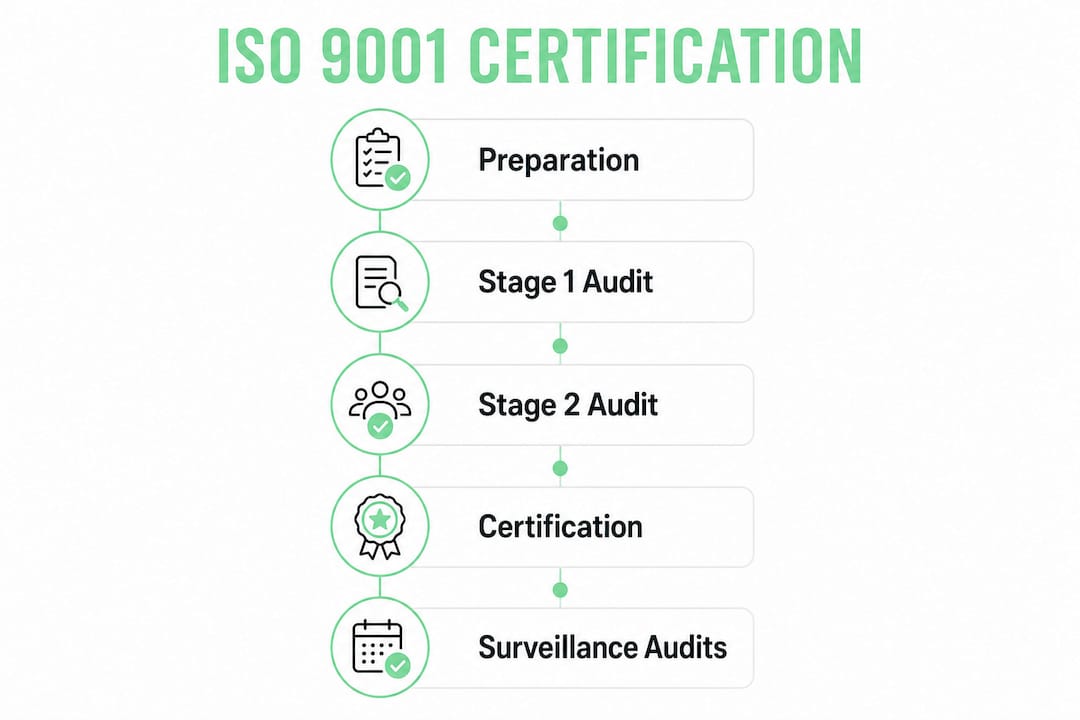
The certification process runs on a three-year cycle. The initial certification requires a two-stage audit by an accredited third-party certification body. Stage one is a documentation review; the auditor checks that the QMS is designed correctly. Stage two is an on-site assessment of whether the system is actually operating as documented.

Third-party certification bodies are accredited nationally, in the United States typically through ANAB (the ANSI National Accreditation Board), which means their certificates carry internationally recognized weight. After initial certification, surveillance audits occur annually or semi-annually to confirm the system stays current. At the three-year mark, a full recertification audit resets the cycle.
Key requirements contract manufacturers must address:
Steps to achieve certification:
One point worth understanding clearly: ISO 9001 certification certifies the management system, not the product itself. A contract manufacturer certified to ISO 9001 still needs separate product testing and regulatory approvals where the product category requires them. The two are complementary, not interchangeable.
Contract manufacturers in specialized sectors often layer industry-specific standards on top of the ISO 9001 base. IATF 16949 applies in automotive, AS9100 in aerospace. Both build on ISO 9001 rather than replacing it, so the foundational QMS work transfers directly.
ISO 9001 does not treat certification as an endpoint. The standard obligates manufacturers to monitor production non-conformities, analyze their root causes, and implement corrective actions that prevent recurrence. This is not optional language buried in a clause. It is a core requirement that auditors check at every surveillance visit.
The practical effect is a feedback loop that gets tighter over time. A contract manufacturer running a mature ISO 9001 system will have years of non-conformity data, corrective action records, and process improvement evidence. That history is what separates a manufacturer who holds a certificate from one who actually runs a quality system.
Continuous improvement under ISO 9001 also shows up in supplier management. Clause 8.4 requires that external providers be evaluated and monitored, which means the quality discipline extends upstream. A contract manufacturer who holds their suppliers to the same documented standards they apply internally reduces incoming quality risk before it reaches the production floor.

Pouchsupply operates as a white-label and private-label manufacturer of nicotine pouches, nootropic pouches, caffeine pouches, and vape liquids, with certification to ISO and Bureau Veritas standards built into the production process. Every client order goes through a formal review before manufacturing begins, capturing formulation specifications, regulatory requirements, and packaging standards in documented production records.
For brands entering the nicotine and functional pouch market, that level of process discipline means your product is manufactured the same way every run, with traceability records that support regulatory submissions and customer audits. Pouchsupply handles formulation, ingredient sourcing, packaging design, and compliance support, so the quality system works for you without requiring you to build one from scratch.
ISO 9001 certification in contract manufacturing is the documented proof that a manufacturer’s quality system is controlled, audited, and built to deliver consistent results for every client order.
| Point | Details |
|---|---|
| ISO 9001:2015 is the current standard | It applies to contract manufacturers of any size and certifies the quality system, not the product. |
| Clause 8.2 is the critical contract manufacturing requirement | Every purchase order must be formally reviewed to capture quality deliverables before production begins. |
| Certification runs on a three-year audit cycle | Initial two-stage audit by an accredited third party, followed by annual surveillance audits. |
| BSI data shows measurable quality gains | 66% of certified organizations improve product quality, 60% reduce production errors, and 65% gain more consumer trust. |
| Continuous improvement is a core obligation | Manufacturers must document non-conformities, analyze root causes, and implement corrective actions. |